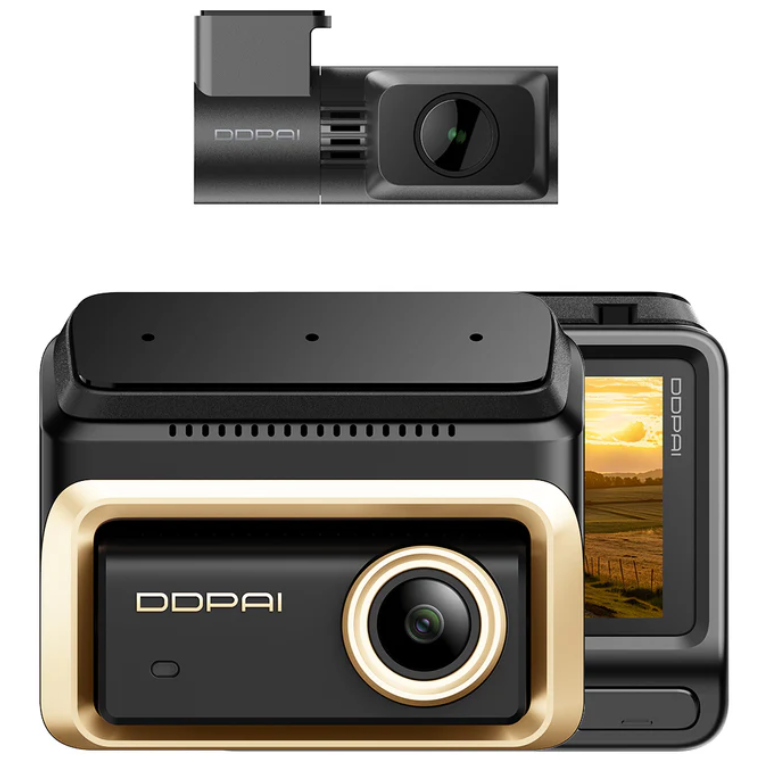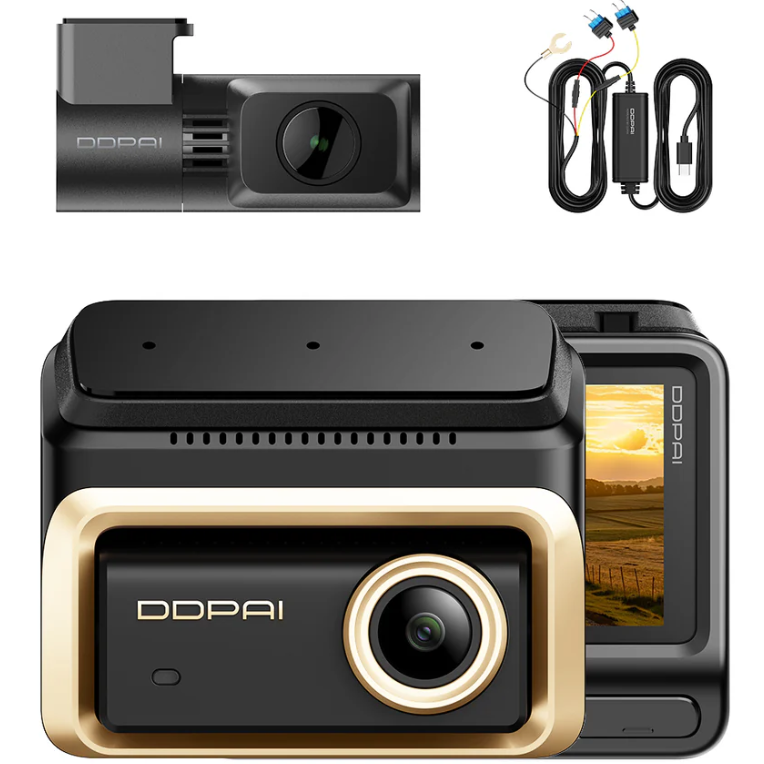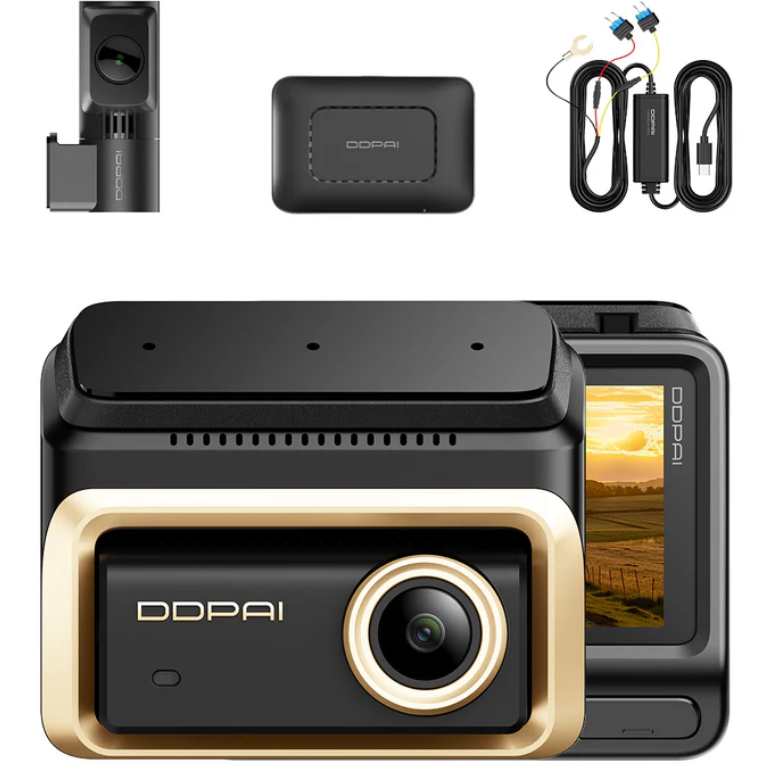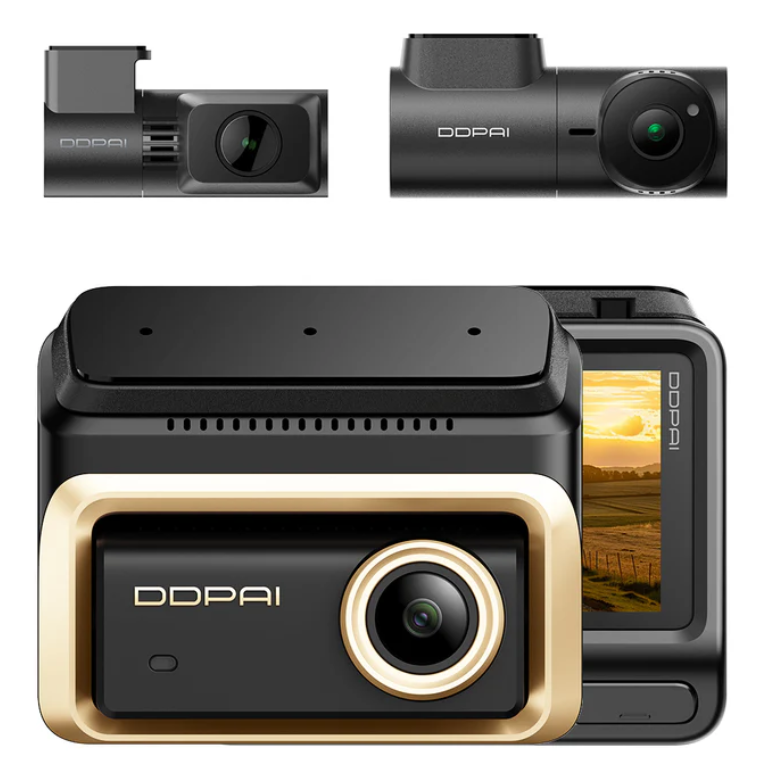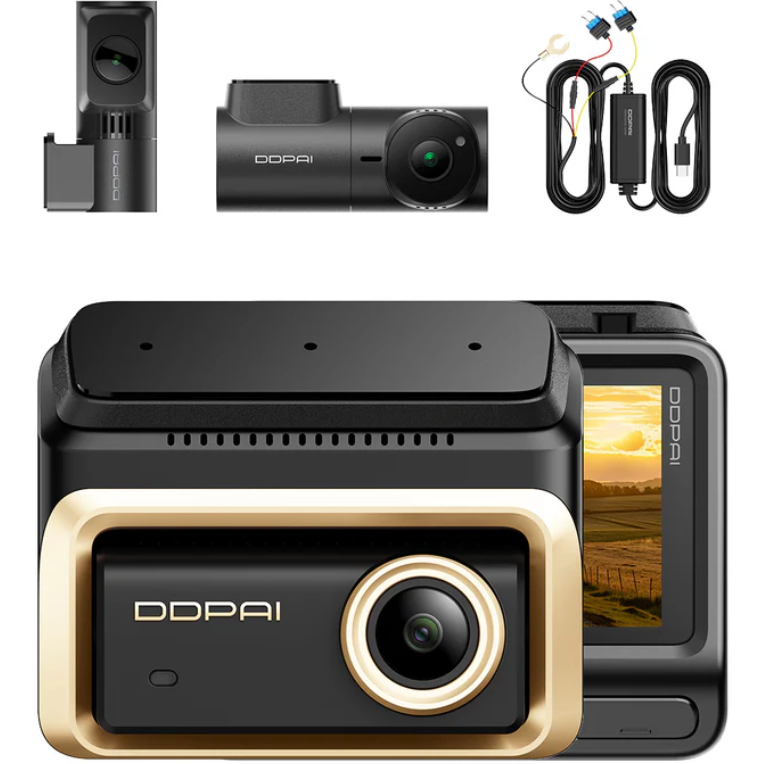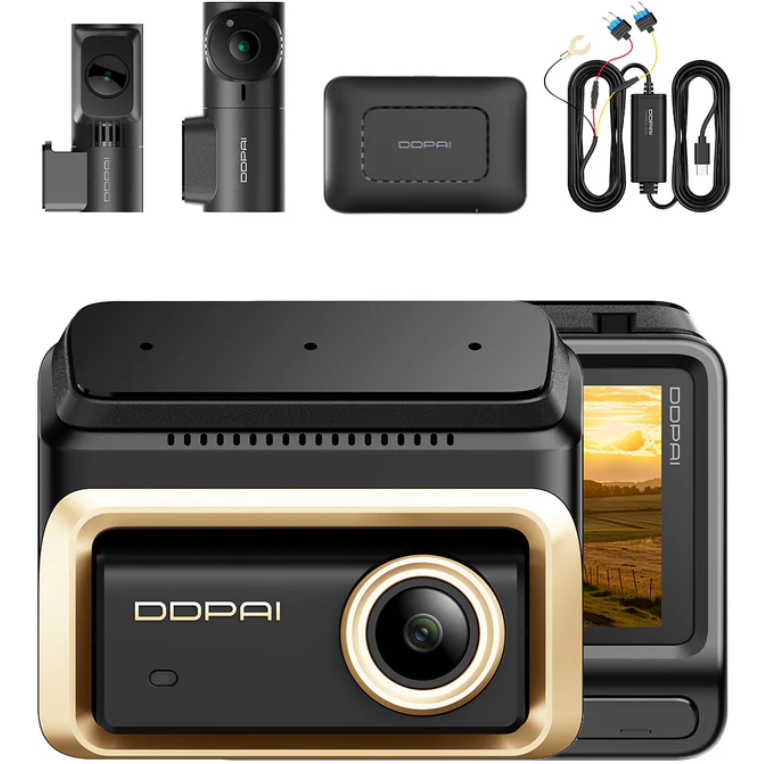
I've never been too interested in video recorders, because it seemed like the choice was simply too big - some cost a few dozen euros, others a few hundred. Are the more expensive models really worth their price, or is it enough to buy any recorder? This time I decided to find out the advantages of a more expensive recorder by testing DDPAI's flagship - Z90 Master with 4G module and "Intelligent Hardwire Kit".
DDPAI Z90 Master
Assessment:
What did we like?
What didn't we like?
What's inside the boxes?
While the package can be listed in text, the unboxing process itself shows everything much better. Therefore, below you will find the full DDPAI Z90 Master unboxing video.
First impressions
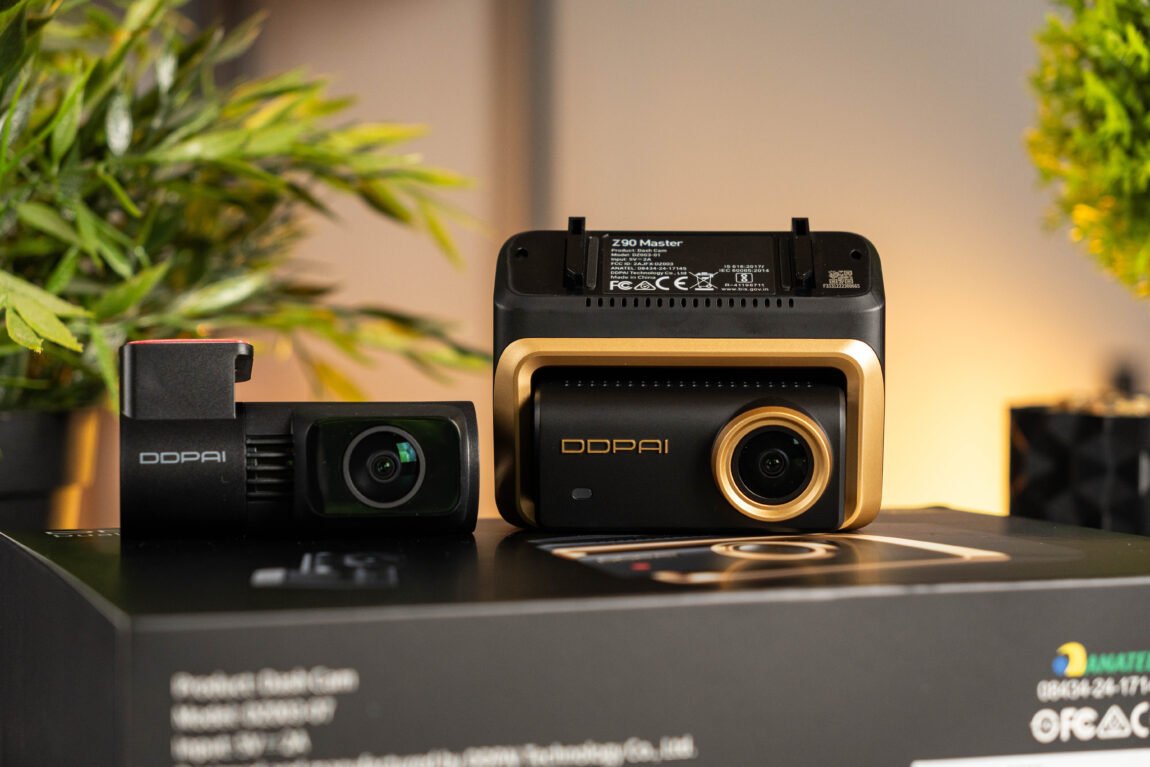
The DDPAI Z90 Master is not the smallest camera I've seen. It has a 3-inch screen and four control buttons on the front. On one side is a memory card slot, and on the other is a power and rear camera connector (both USB-C). On the front is the camera module itself, the angle of which can be adjusted up or down. The camera is quite heavy, which immediately creates the feeling of a more solid, higher-end device in the hand.
I understand that the gold frames around the camera are part of the design and really add to the uniqueness, but the question immediately arose - will such bright elements not be reflected in the image itself? Also, in my opinion, such details can attract the attention of long-fingered people more. I think that a less noticeable design of video recorders is always an advantage.
The rear camera looks more like a traditional small recorder (especially the 70mai 300 model). Its angle is also adjustable, and there is only one connector, for connecting to the main camera. The cables included in the kit are long enough, so they should be enough to run in almost any car.
As for accessories, the 4G module somewhat resembles a TV set-top box, although it is much smaller. It is designed for remote connection to the camera and constant monitoring of the car. It is connected to the main camera using its power connector. Unfortunately, the connection cable is quite short, and the connector itself is thick, so it is much more difficult to hide it than the cables of the main camera. Due to its length, the module can only be attached to the glass or left on the panel, and for a neater installation, you may have to turn the head.
DDPAI offers three ways to connect the camera to the car - a standard cigarette lighter socket, fuse sockets or via OBD connector. For testing, I received the "Intelligent Hardwire Kit", which allows you to connect the camera directly to the car's fuses and is one of the most convenient solutions for long-term use. The connection itself is not complicated, but it takes a lot of time to neatly hide the wires under the car's interior trim.
Overall, I am satisfied with the quality of all parts. The main camera looks really solid, the plastic is not cheap, and the screen resolution pleasantly surprised me. The rear camera, as expected, does not take up much space and does not attract too much attention while driving. The only slight disappointment is the length of the 4G module cable and the rather large connector.
DDPAI app
In addition to the quality of the video, it is equally important how quickly and conveniently you can access the recordings themselves. The most convenient way to do this is with the DDPAI app. Most of its features have already been discussed by Tomas in the previous article. DDPAI Z60 Pro in review, so I will only share my observations here after longer use.
While the app is stable and has plenty of features, I didn't find its layout to be the most intuitive. Some settings took a lot of searching - for example, changing the speed unit from mph to km/h took a lot of digging through the menu to find it.
I also missed more recording management options. I would like to be able to choose how long recordings are stored, when they start to be overwritten, and how the internal memory is used. Currently, the internal memory and the memory card are filled to capacity, and then the oldest recordings are overwritten. Since the Z90 Master has both built-in memory and a microSD card, it would be convenient to automatically save recordings to both media as a backup, but there is no such option here either.
I also noticed one strange software solution. Although only the main camera has a microphone, audio recording can be turned on for both the front and rear cameras. When it is turned on for both channels, the audio is linked to the rear camera recording, so when viewing the front camera image, it simply will not be there. Fortunately, this is easily solved by simply turning off audio recording for the rear camera, but it would be nicer if such a manual fix was not necessary at all.
I really liked the timeline view - it allows you to find the right place in the recording really quickly. However, when downloading videos, this convenience disappears a bit. After downloading a recording from one camera, in order to save the image of the same moment from another camera, you have to search for that place in the timeline again. In addition, after the download is complete, the app automatically returns to live view, so you have to repeat all the steps to download another file.
Video quality
The biggest advantage of the DDPAI Z90 Master, at least in my eyes, is the image quality. The Sony STARVIS 2 sensor, already seen in the Z60 model, together with the HDR system, ensures good results not only in ideal conditions, but also in difficult situations. After numerous tests and video reviews, I can say that this is where the camera pleasantly surprised me.
Front camera
The image quality of the front camera left a very good impression in all conditions. When driving against the sun, HDR copes well - bright areas do not burn out, and there is enough information in the shadows. True, my fears about the golden accents were partially confirmed - at certain angles they are reflected in the image. It is possible that this is influenced by the curvature of the car glass or the chosen installation location, but in my opinion, a completely black design would have been more practical.
The DDPAI Z90 Master is at its best in good weather conditions. When you stop the image, license plates can usually be read from about three cars away, and road signs and other small details remain clearly visible. The CPL filter also does its job well and reduces unnecessary reflections.
The camera also performed very well in rapidly changing conditions. When driving in the rain, license plates remain visible, and when exiting a tunnel, the camera adapts to the changed lighting quite quickly. Sometimes you can notice a momentary change in white balance, but the detail is almost unaffected. Even a bright sky does not spoil the overall image, and the exposure quickly balances out.
At night, oncoming car headlights or bright advertisements do not create large white spots, so you can usually still see license plates and road signs. True, a lot depends on the speed of movement - it is much easier to recognize license plates or signs when standing still than when driving. However, this is typical for almost all video recorders and the DDPAI Z90 Master performed really well here.
Rear camera
Before the video analysis, you can evaluate the performance of the rear camera during the day, in the rain, and at night in the video below.
The rear camera also shoots in 4K and uses the same Sony STARVIS 2 sensor, but during my use, its image still appeared to be less detailed than the front camera. The difference is most noticeable when the image is frozen - small details such as license plates or road signs are not as sharp. However, when viewed during normal driving, the image remains high-quality and is certainly sufficient for everyday use.
During daytime driving, the rear camera manages to maintain good detail and copes well with different lighting conditions. In the rain or in poorer conditions, the difference from the front camera becomes more noticeable, but the most important information is still captured. At night, the image also remains quite clear, although it becomes much more difficult to recognize license plates or fine details than with the front camera.
It is likely that this is influenced not only by the camera module itself, but also by the car's rear glass - its angle, tint or light transmission can significantly affect the final result. Another possible reason is the lower bitrate of the rear camera recording - although the resolution and sensor used are the same, a larger amount of data is allocated to the main camera. However, in real use, this difference is not so great that the rear camera would seem to be the weak point of the set - it simply does not match the very strong front camera.
Parking mode
One of the biggest advantages of the DDPAI Z90 Master is the ability to monitor the car even when it is stationary. This recorder requires constant power, which is where the Intelligent Hardwire Kit comes in handy. It not only allows you to use parking mode, but also protects the car battery - in the app you can set the voltage at which the camera will automatically turn off. For example, if you set a threshold of 12.4 V, the camera will no longer turn on when the battery reaches or drops below this level.
Parking mode has several operating modes. The camera can continuously record in normal mode, record at time intervals (timelapse), or operate in sleep mode, when it remains in standby mode most of the time and turns on only when an event is detected. It is also possible to adjust the sensitivity, but it should be set responsibly - too high sensitivity can generate a number of false alerts, for example, due to a louder car passing nearby or other movements in the environment. Monitoring can operate for up to 48 hours, and using the 4G module, you can immediately receive a notification about the event on your phone.
Personally, I use sleep mode most of the time because it seems to be the best compromise between protecting the car and saving battery. Of course, no camera will guarantee complete protection, but knowing that the car is being monitored and the event will be recorded gives you an extra sense of peace.
4G Cloud Box
Mobile connectivity is no longer a novelty among higher-end video recorders, but it is still quite rare. DDPAI 4G Cloud Box allows you to remotely connect to the camera, view live video, receive notifications about recorded events, set a geographic area (geofencing) and download emergency recordings (emergency recording). All this works stably and is especially useful in parking mode.
The most surprising thing was that you can't browse all the recordings on the camera remotely. Only emergency recordings are available, so if you want to view a specific older video, you won't be able to do so. It's possible that this solution was chosen to save mobile data or the car's battery, but it was still unexpected to see such a limitation in functionality.
Personally, I probably wouldn't choose the 4G module for everyday use. It's another monthly subscription, and I've only needed it a few times. Also, every notification on my phone about a detected event makes me worry for at least a moment until I open the app and see what really happened. Most of the time it turned out to be just a more sensitive system.
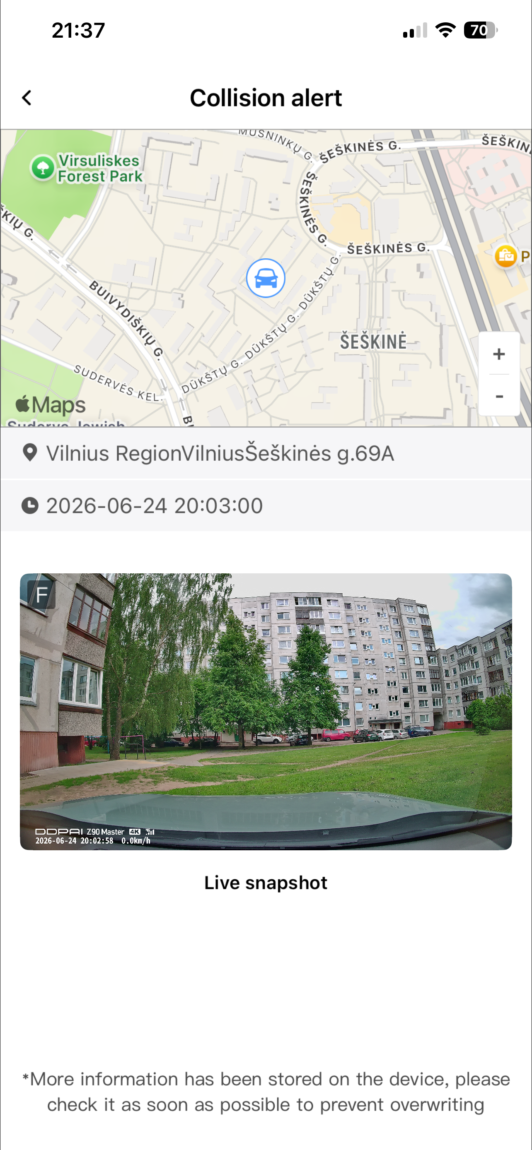
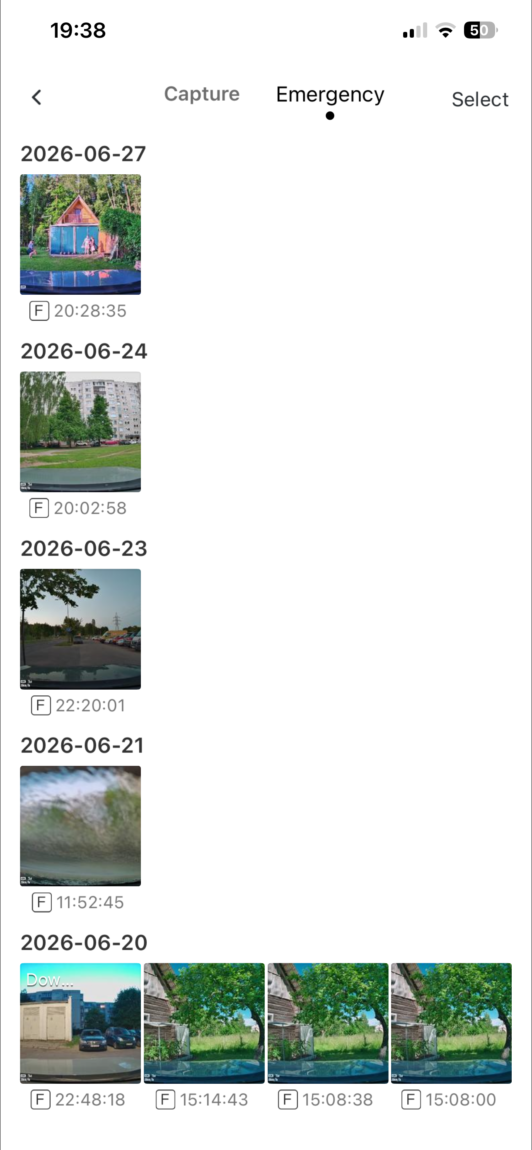
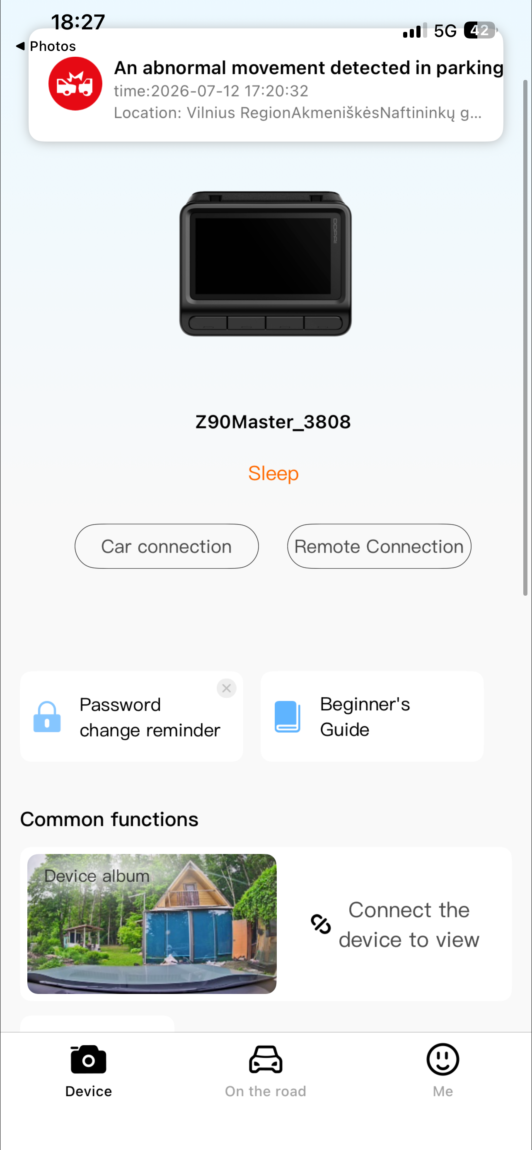
Another thing I didn't like was the module itself. It's quite large, and the connection cable is quite short, so it's not easy to hide it neatly. For this reason, I wouldn't consider it a reliable car tracking tool in case of theft - if the recorder is noticed and disconnected, the 4G connection will also stop working. In my opinion, it would have been much more practical to create a smaller module that could be hidden, for example, next to the fuse box.
Additional observations
When using a dash cam every day, you notice various little things that may not be decisive when choosing a camera, but they really improve the overall experience. One of them is the integrated GPS. The location and speed of the car are saved in each video, so if necessary, you can easily trace not only the route, but also determine exactly where and at what speed you were driving. Although this information is unlikely to be needed every day, it can be very useful in the event of a traffic accident.
Another thing worth mentioning is the supercapacitor. Unlike cheaper recorders that often use a regular lithium battery, the DDPAI Z90 Master uses a supercapacitor. The difference is not noticeable in everyday use, but in the long run it is a more reliable solution. Supercapacitors better withstand summer heat and winter cold, wear out more slowly, and in the event of an unexpected power outage, they allow the camera to safely complete the recording.
Although I usually only use the dash cam screen for initial video previews or to change settings, I was pleasantly surprised by its quality. Even on a bright sunny day, the information on the screen remains clearly visible, so I don't need to connect to my phone just to quickly review the latest recording.
DDPAI also offers several AI-based features. One of them tries to recognize the speed of cars driving nearby and display it on the screen. Although the accuracy of this feature is not so reliable, it is quite interesting to watch it work. I also liked the animations of the AI assistant. They provide almost no practical benefit, but they give the camera more character. True, they left the biggest impression not on me, but on the child.
During use, I also noticed one situation that initially raised a lot of questions. When reviewing the recordings several times, I found short periods when there was simply no video, although the camera worked normally before and after them. After checking the recording times, I noticed that they coincided with moments when the car battery voltage had dropped below the limit set in the app. Most likely, this caused the recorder to briefly turn off in order to protect the battery, although I cannot completely rule out other reasons, such as overheating. However, I was unable to determine the exact reason. If you are using the Intelligent Hardwire Kit, I would recommend carefully choosing the shutdown voltage limit to prevent such situations from happening again.
Finally, it's worth mentioning the built-in internal memory. I trust the latter more than memory cards. However, it would be even more practical if the app could choose to automatically save recordings to both the internal memory and the microSD card as a backup. I miss that option at the moment.
Z60 Pro or Z90 Master?
Although the DDPAI Z60 Pro and Z90 Master use the same Sony STARVIS 2 sensor, the image quality between them is still noticeably different. During the day, the difference is not large, but the Z90 Master retains details in the shadows better, and when the image is frozen, car license plates and road signs usually look brighter. The difference is even greater at night - bright advertisements, lights or other light sources "blow up" the image much less, so more visible details remain. In some cases, the Z90 Master even manages to read illuminated advertisements, which are already harder to see or not readable at all in the Z60 Pro recording.
Verdict
The DDPAI Z90 Master left a very good impression, but it is not a recorder that I would recommend to every driver. Its strongest point is the image quality. The Sony STARVIS 2 sensor, HDR system and good performance in difficult conditions make you feel confident that the recording will be detailed enough at the most important moment. This is also supported by a reliable parking mode, supercapacitor, integrated memory and additional functions that raise the overall user experience to a higher level.
However, the rather high price does not mean that there are no compromises here. The 4G module sounds like a very useful feature, but in reality it is an additional expense, and the module itself could be smaller and more conveniently installed. I would also like a more convenient app and a few additional settings, especially related to recording management.
If you're looking for a simple DVR just to have video footage in case of an emergency, the DDPAI Z90 Master is likely to be too expensive. However, for those who want one of the best DVRs with additional security features, remote monitoring, and a more durable solution, this model is one of the more interesting choices.